Just finished this fabulous consultancy where so much of my creative work overlapped seamlessly with my work as an instructional designer. Was delighted to let world-building be the way to achieve pedagogical aims.
Thursday, April 15, 2021

Sunday, November 22, 2020
Undaunted wins the SPP Award 2020!!!
Delighted to receive the Sultan Padamsee Award 2020 for my play Undaunted. Second time I've picked this award up, I won it in 2011 for Ultimate Kurukshetra. Thoroughly enjoyed this short little extract from the first draft of the piece.
My reaction was to promptly schedule some time to redraft the script. Sigh! As a playwright one does not write a play, one rewrites it!
Undaunted: Synopsis
A passenger stranded aboard a quarantined cruise ship tries to spin a yarn. The ship’s steward though, seems to be spending way too much time on the internet. The story feels like a blast from the past.
February 1946: The steam ship SS Undaunted enroute to Bombay is unable to make landfall as the city and country are in the midst of an insurrection, the Royal Indian Navy uprising. Clandestine actions on the deck reveal five people with hidden pasts embroiled in a mysterious operation.
Nadia a sultry film-star, Roshan a suave banker, and the enigmatic Mira draw the attention of Jai, a cop with a violent streak. Ibrahim, a lascar, has been sailing on steamers for forty years. He wants to go home.
Starting at the cusp of India’s Independence, and at the close of World War 2, the deck of the Undaunted opens out into the intricate tapestry of maritime India in the first half of the twentieth century. The zig-zag journey of characters between Madras and Penang, Bombay and Aden, London and Durban, intersect with iconic moments in the lives of Indian political thinkers, and the glitzy world of cinema.
With a nod to the noir genre, Undaunted propels us into a vivid dreamscape, where journeys are made over water and discoveries are made in the deep.
Friday, October 30, 2020
Undaunted: A reflective essay on dramaturgy
The creation of art in times of global turmoil is not a luxury, but a necessity. Even as we must pause to fathom the tremendous loss of life and social turmoil caused by the Covid19 pandemic in India and the world, as artists we must be aware of the role we must play as the period of lockdown ends. When we emerge on “the other side”, we might find a world drastically transformed. Artists and art will be needed to mediate forces that will try to constitute the new normal, even as we experience an alarming retreat from democratic norms in the present crisis.
The playwright Howard Barker
offers us a compelling metaphor of his conception of the theatre - the theatre of
catastrophe. This construction “…takes as its first principle the idea that
art is not digestible. Rather, it is an irritant in consciousness, like the
grain of sand in the oyster's gut...” While Barker’s invocation of
catastrophe is to jolt the complacent audience with a feeling of sensorial
excess and contextual disjuncture, at present we find ourselves in a literal
catastrophe. As a playwright continuing to work in these difficult
circumstances, I share this, and additional ideas on how the play Undaunted
has taken shape.
One of the stated aims of this
play is to render on stage a kind of worker’s consciousness. The lascar
as an Indian seafarer may be socially constructed through biography and
historical record. However, the play seeks to evoke the lascar, not as an
individual produced by social forces, but instead the beacon holder of a
particular shared worldview. This is one marked by mobility, the ability to
move from port to port, to be exposed to new ideas and cultures and to land up
at unusual and remarkable places. At the same time there is also a sense of
constraint, where the ability to disembark or “jump ship” was regulated and
racial prejudice was deployed as a means of control.
In this play the attempt to
capture consciousness has resulted in a mix of registers, using dreams,
memories, contemporary memes and historical fact as source material. The wide range
of registers is deliberate, as it confounds the easy relegation of the subject
as a distant matter for historical contemplation, or one relevant to high or
low culture. As agents of early globalisation, the lascar’s world is brought to
the foreground and scenes of migration and travel under extreme duress resonate
with contemporary images of migrant labour “cut loose” by the government to
fend for themselves.
One of the formal choices of the
play has been to adopt a closed space, open time format. This is a
rubric that creates a relatively bounded space, the deck of a ship, as the main
setting. The closed space has different configurations, such as an upper deck
and a lower deck, typically indicating class differences of passengers. The
setting in time however, remains open, with the play alternating between the
present and the past. Although we are locked into a single physical space, the
action of the play flits across time, roughly covering the first half of the
twentieth century.
This play mixes genres. I
do not want the play to be seen as a historical play or a period piece. The
events, though they occur in the past are conflated with the present. This is
meant to reflect the contemporary moment, as one aspect of the public narrative
around Covid19 is the uncanny re-articulation of earlier historical periods.
The most obvious parallel is the Spanish flu of 1918, but the referencing to
World War I and II by political leaders across the world is also marked, as is
evocation of the great economic depression of the 1930s. The time signatures present
in the play mimics the present as a meta-narrative for a regressive slide into
the past.
For example, the play switches
into narratives derived from popular cinema at the time, across Hollywood and
Bollywood. Based on researched historical fact, we are taken behind the scenes
of the 40s film-noir murder mystery Calcutta shot at Paramount studios,
where about 200 lascars worked as extras on location. We also are taken on
board the SS Rajputana which is actually a film-set for the idealistic classic
Dr. Kotnis Ki Amar Kahani directed by V Shantaram at the Rajkamal Kalamandir
Studios in Bombay. Similarly, we are also witness to legendary maritime journeys
of Indian political figures such as Ambedkar, Gandhi & Savarkar at pivotal
moments in their lives, prior to their emergence as major figures in the Indian
independence movement. We also experience a legendary maritime journey based on
historical fact, the story of the SS Komagata Maru which was denied permission
to dock at Vancouver in 1914.
Lastly, the play is a journey
over water for the characters and audience. This is an ethereal metaphor
evocative of spiritual growth, the movement from one phase of life to the next,
or even the movement beyond this life to the next. One origin for this metaphor
comes to us from Greek myth where the boatman Charon ferries recent dead across
the river Styx and Acheron in the afterlife. In the play the characters all
experience this journey in different ways.
I am keenly aware that this play
was written at a moment of terrible loss. I believe that the heart of the play,
as evoked in the spirit of the lascars, is the journey of hope. Despite the
terror of the unknown, we journey forward. Despite our plans dashed, our vision
obscured, and the unbearable weight of grief, we must journey onwards with love
and light in our hearts.
Written 15th May 2020
Thursday, August 20, 2020
Theatre in the time of Covid19: Innovations and setbacks
The global pandemic has created massive disruptions in the theatre community, and I was recently asked to respond to this topic. The article that was published online left a lot to be desired when it came to quoting my responses in context. The sub-editors headline "trying to keep the theatre alive" was also sufficiently cringe worthy enough for me to put out this short clarification.
POST SCRIPT: Relieved to report that the article was subsequently edited to keep my quotes in context. The headline was also softened from "trying to keep the theatre alive" to "keep the theatre going". Small victories!
The pandemic has created both positive and negative outcomes: innovations and setbacks...
Innovations:
1. A large proportion of the theatre community has made the transition to online work. We've moved performances and workshops to social and streaming platforms, Zoom, FB, Insta Live etc. Multiple generations of theatre people from experienced veterans to younger digital natives are all grappling with this change.
2. Our sense of theatre community has been reconfigured. We now find ourselves working across multiple time zones and locations. At AEIF, we have had workshop participants from Singapore, Malaysia, Toronto, across India etc.
3. Content innovations are taking place. Some of us have shifted closer towards radio/podcasting as a “hybrid format”. This is actually quite interesting since there is a sense of visual fatigue that occurs from being online staring at screens all the time.
4. Theatre is about active experience – so we have moved even further away from the sensational visual towards the process of active listenership. This ethos of experiencing a story is totally opposed to “binge watching” content on OTT platforms.
5. Theatre is about a social experience, so “eyeballs and footfalls” are not so important as the building-reconfiguring of our community/audiences/ecosystem in this moment of flux. When we move online we're not looking for millions of hits on YouTube but for those who see value in the story that we are telling and participate with us in the act of storytelling.
Setbacks:
1. Where social disparity and the digital divide existed earlier, it has been made worse. Folk and rural artists are disproportionately hurt.
2. Professionalisation in the arts, which in India was always patchy and uneven, has faced a massive setback through theatre closures. This has hurt independent/freelance practitioners who go from gig to gig quite a lot. The hurt is felt not just by the artists (actors, creative team etc) but the whole creative ecosystem (the theatre staff, the technicians, the backstage crew, the chaiwallah and the dhobiwallah!) all of whom are part of the theatre ecosystem, though sometimes not directly visible.
Key takeaway:
We are seeing exceptional resilience and adaptation in the community, even in the face of gloom and doom all around. The ghost lights kept burning in the closed theatres are a symbol that we are keeping our creative spirits strong!
Saturday, June 27, 2020
Script Writing Fundamentals - An Online Dramatic Writing Workshop
Here's a bunch of FAQs about the workshop. (You can tell how long I've been writing, by the fact that you are seeing this on Blogspot!!!)

What is this workshop
about?
This workshop covers script
writing fundamentals for anyone who wants to create a dramatic text - a stage
play, a film script, a radio play, or a web series. Through the sessions we will
cover foundational ideas like how to craft plot, character and dialogue.
We will also work with myth,
dreams and archetypes through the Hero’s Journey – a very popular industry
format with screenwriters. A dramatic text can also be informed by painting and
music, and we will gain insights from these forms of expression to enhance our
ability to craft drama.
Research skills will round off
the basics. We will learn how to complement our imagination and personal
experience by sourcing real-world material to inspire our art. Fact is often
stranger than fiction! With a bit of training, we can make that work for us.
Who can attend?
The script writing fundamentals
workshop is meant for writers working in any dramatic medium, primarily theatre,
film, radio or digital. Some of the methods can also benefit those working in
narrative fiction looking to fine tune an ear for dialogue or refine their
plotting. Right from stand-up comics looking to generate material, through to
screenwriters pitching for a web series, there will be something for everyone
who wants to write a script.
What are the sessions like?
The workshop is made up of three units
- Workshop intensive
- Interactive sessions
- Script Mentoring
The workshop intensive is made up of 6 sessions of exercises, with sharing of tools and methods.
There will be 3 interactive
sessions with practitioners from the field.
A month-long mentoring session
follows, where you can receive professional feedback on a script that you are
working on, rewriting or have created as an outcome of the workshop.
All sessions will take place over
Zoom. Each session will be 2 hours long.
When are the sessions?
We will work on weekends (Sat
& Sun) in July from 6pm – 8pm starting 11th and 12th of
July.
Interactive Sessions will be
scheduled through August. Mentoring will be scheduled individually.
There will be a final online
reading of our work in September.
What will you charge?
The workshop fee is INR 9000/-
all inclusive. This covers nine sessions and the individual mentoring on a
script of your choice.
If you would only like to attend
the sessions, without the mentoring then the fee is INR 7000/-
Student discounts and concessions
are available on request.
What exactly will we learn?
Here’s a brief overview of some
of the things we will cover.
Plotting – the classic approach
to revelation and the reversal
Character – getting a grip on wants
and obstacles
Dialogue – the psychological
approach
Dialogue – the speech genre
Hero’s Journey – working with myth,
dreams and archetypes
Time, Space and Setting – Engaging
multiple art forms for insights
Research skills for writers –
methods and tools
How do I sign up?
Sign up using the Instamojo
link https://imjo.in/3FtNek
Saturday, April 25, 2020
Closing in on the first draft of Undaunted

Sometime to feel the movement of a play you need to get it out into some physical form. This is a technique screenwriters use all the time, but I found myself using it for my play about Indian seafarers. It was far more satisfying than my Scapple arc, but well... if the movements are more complex and granular you can make a map like this one to keep track of things.

Sunday, February 16, 2020
Screenwriters Event

What a fun conversation between two super screenwriters - Anjum Rajabali and Juhi Chaturvedi. I must say I am a very happy Scrrenwriter's Association of India Fellow Member!
Monday, February 03, 2020
Meeting old friends!
Saturday, January 25, 2020

Saturday, November 23, 2019
Ultimate Kurukshetra at the Esplanade

What a kick ass show of Ultimate Kurukshetra at the Esplanade!!!

What a bunch of stars! The back stage team were stellar! Take a bow! You deserve it!
Saturday, November 16, 2019
Yuyutsu - the very famous Kaurava Prince - er... who?
The character of Yuyutsu in the Mahabharata presents us with a curious case of a Kaurava prince who fought on the Pandava side at Kurukshetra. Yuyutsu it is said, accepted King Yudhishtra’s eleventh hour invitation to anyone who wanted to switch sides before the start of the battle, ostensibly, onto the “right” side of dharma. In a morally unambiguous worldview, the Kauravas were the “bad guys” and one can only imagine the reasons why Yuyutsu would realise at the last moment that he ought to actually be with the “good guys”.
 |
| RGK as Yuyutsu, the Kaurava with a conscience. |
Of course, once the fighting started transgressions and excesses occurred on both sides. What was a dharmic action and what was not, and from whose point of view, is the stuff of soaring philosophical debate that makes the characters in the Mahabharata so complex, and the idea of dharma so perplexing. In Ultimate Kurukshetra the ethical dilemma behind Yuyutsu’s crucial decision is presented as the epic narrative frame, into which we are thrust into the on-ground action in medias res.
To know more come be a part of the Ultimate Kurukshetra journey…
Friday, November 15, 2019
The wax palace burns
 |
| Harish Seshadri as Adi |
The burning of the wax palace (Lakshagraha) or the house of lac is a minor moment in the Mahabharata. The Pandavas find out about a plot to kill them, hatched by Duryodhana and an architect of ill-repute Purochana, when they are living in a small settlement called Varnavata. The Pandavas turn the trap to their advantage, setting off the fire themselves to cover their escape via a secret tunnel. In an ethically troubling decision, the Pandavas hoodwink a Nishada woman with five sons into staying at the house of lac the night of their escape. Their charred bodies served as plausible cover to make it seem that the Pandavas perished in the trap. When read as an instance of “structural violence” the incident is a grim reminder about political violence that can tear apart a society and pit one community against another. In Ultimate Kurukshetra, the burning of the wax palace cuts short Adi’s urban aspirations and turns him into a bitter man, hell-bent on revenge. As Maya says about Varnavata after that terrible incident, “The city was never the same.”
To know more come be a part of the Ultimate Kurukshetra journey…
Thursday, November 14, 2019
It’s all Maya…
 |
| Mallika Prasad as Maya in Ultimate Kurukshetra |
The women in the Mahabharata are figures of towering grandeur and pathos, full of dignity despite hardship and insult, ever so noble in their stoicism, human in their suffering and their rage against injustice. Yet, the feminine perspectives offered are predominantly of the nobility, who despite their high social status, are politically constrained in their ability to take independent decisions. It is no surprise that the patriarch Bhishma, evades Draupadi’s question to the court, when she has been lost by King Yudhishtara in the game of dice. Was she lost before or after Yudhishtra lost himself? Can someone who has lost their own agency, stake another? The status quo answer Bhishma provides is unsatisfactory, a canard that hinges on a subtlety of dharma. In Ultimate Kurukshetra Maya is stunning in her self-reliance and not being from courtly life, is capable of a series of bold decisions and life choices. Her zig-zag journey to Kurukshetra takes her to the decadence of Shalya’s camp (paternal uncle to the Pandavas but fighting on the Kaurava side as a result of a political quirk), and her dazzling intellectual contribution to the world is something of a twist!
To know more come be a part of the Ultimate Kurukshetra journey…
Wednesday, November 13, 2019
Acquiring divine weapons in the Himalayas
 |
| Internal or external journey? Karn Malhotra as Sudarshana |
In the Mahabharata Arjuna spends time in the mountains meditating and acquiring divine weapons. His steadfast concentration and intense mental focus are legendary, given that he was (arguably) the best archer in the world at the time. However, one can’t help wondering that wandering off into the mountains was less about mystical revelations and magical powers, as it was about creating strategic alliances and confederacies with the mountain dwelling clans and tribes. The acquisition of power might have been less about divine interventions and heavenly gifts from gods, and more about learning new modes of warfare and innovative tactics from the constantly warring clans of the region. So is this journey of acquiring divine power an internal or external one? In Ultimate Kurukshetra, this is the question that confounds Sudarshana, as he searches for answers. His search takes him away from the blissful seaside of Gomanta, to the icy scree of the Himalayas, to the scrub of the final battle at Kurukshetra. As he learns to manipulate time (sometimes knowingly and mostly unwittingly) he makes a profound discovery.
To know more come be a part of the Ultimate Kurukshetra journey…
Tuesday, November 12, 2019
The Mahabharata as a frame narrative
 |
| Stories within stories in Ultimate Kurukshetra |
The Mahabharata as a narrative structure is mind boggling. Eighteen books, a hundred thousand verses, accretions, redactions, interpolations… reams of scholarship have been committed to this field of study. It is also a frame narrative, where the story is nested within dialogues between characters (Vaiśampāyana-King Janamejaya, Ugraśrava Sauti to an assembly of sages, and others). The legendary author of the narrative (Vyasa, Krishna Dvaipāyana according to some), is also a character within it. Ultimate Kurukshetra mimics this story-within-a story structure. The story is presented in multiple narrative frames, and in the microcosm of the stage, humbly pays homage to the greatness of the epic. The play takes as a starting point that even the very small action, matters in the face of the very great moment!
To know more come be a part of the Ultimate Kurukshetra journey…
Monday, November 11, 2019
The Burning of the Khandava Forest
 |
| Anirudh Acharya as Daksha. |
The burning of the Khandava forest in the Mahabharata is a relatively minor incident. Arjuna and Krishna level a forest, on which the Pandavas build their capital city. One point of view, is that the Pandavas required a stronghold from which to rival the Kaurava capital of Hastinapura. However critical engagement of this incident from other points of view question this pragmatic explanation. The ecological devastation wrought by the Pandavas was total, killing (almost) every living thing in the forest. There is also the terrifying prospect that this was genocide, where a clan intent on establishing a settled polity, butchers the itinerant tribes and indigenous peoples. This pattern is grimly familiar, as the march of development and urbanisation struggles to reconcile with ecological approaches. In Ultimate Kurukshetra, this minor incident in the epic destroys the livelihood of the forest dweller Daksha. The words he utters, “What about us?” in the face of Arjuna’s destructive inferno chills my heart to this day.
To know more come be a part of the Ultimate Kurukshetra journey…
Friday, December 28, 2018
At the Times Lit Fest with Monolith
Some scenes from the Times Lit Fest where I spoke about my short story - Monolith. Monolith is set in the aftermath of the battle of Talikota, and offers an alternative perspective on the destruction of Hampi. It seeks to demolish the trope of the "invader" that functions as a kind of monolith of the cultural imagination! One look at the actual monoliths that surround Hampi makes you somber indeed. I suppose it takes a playwright working in a medium that is not normally his strength, to make this epochal moment in history, also moment of quiet heartbreak. Ah well, if the subject needs stone faced gags, so be it!

Monday, March 05, 2018
Spaces Between Words: The Unfestival
The breath taking ruins of the Vijayanagara empire at Hampi form the perfect backdrop for a writers’ conclave. One could not ask for a better place to inspire creative output, provoke reflection and trigger curiosity about the rich history of the region. Eight writers across different literary genres gathered at the Vidyanagar Township, Torangallu between the 19th and 28th of February 2018 for the conclave, which was presented with the generosity of the JSW Foundation, in association with the Hindu. Based at the stunning Kaladham, writers spent ten days working on new material, interspersed with visits to the surrounding historical sites and JSW facilities.

Kaladham: Pic courtesy JSW
Kaladham is a ten-acre symphony in granite, with lush greenery and dazzling architectural design; it is an arts village with a museum dedicated to the UNESCO heritage site of nearby Hampi, and the perfect location for a writing retreat. The quiet energy of the space, the stimulating interactions and the wonderful atmosphere in the township made the experience truly immersive. The creative dynamo who made it all come together was Sathya Saran, who curated this “unfestival” - a gathering meant to be involved, intimate and atypical relative to more spectacle-centric literature festivals.
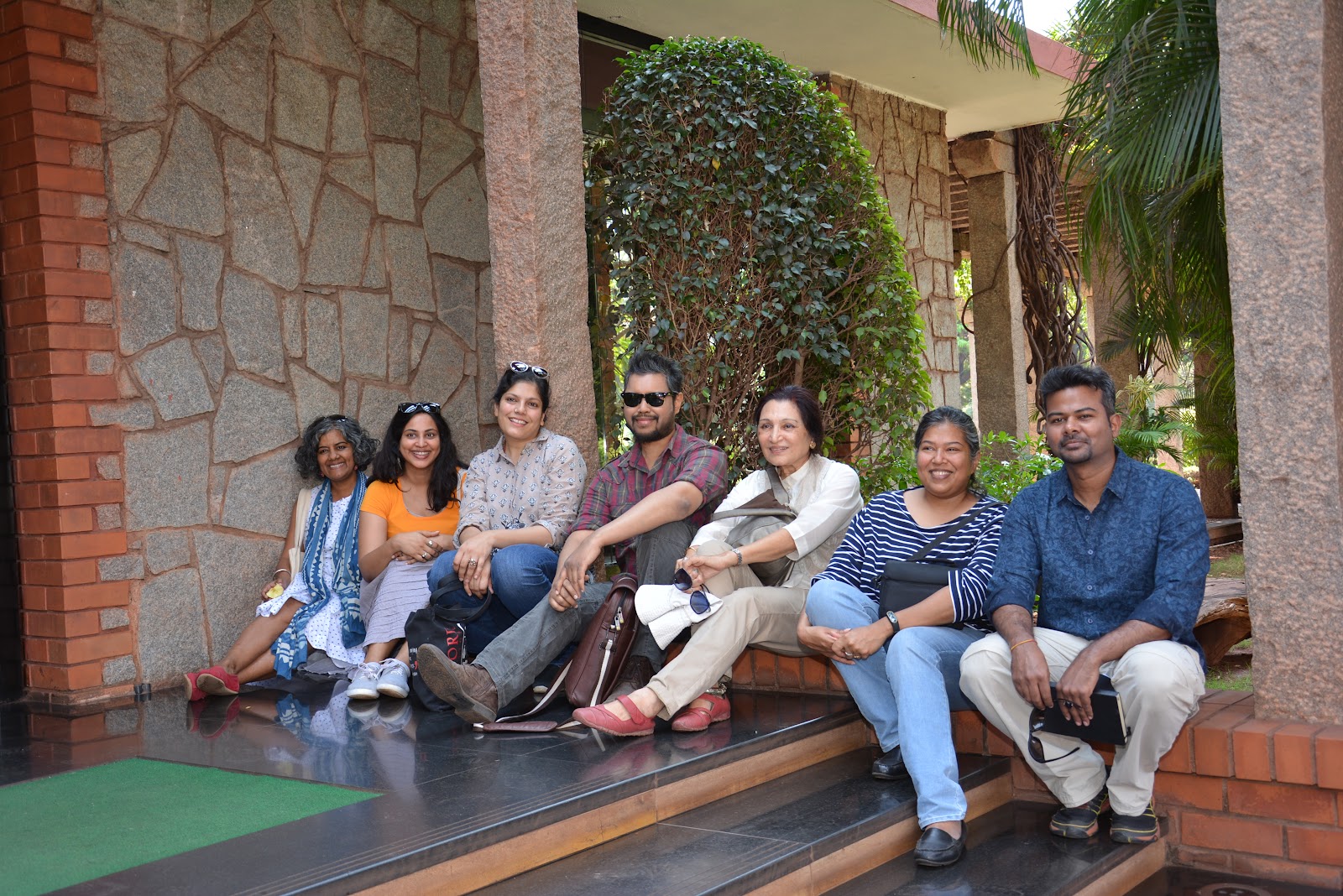
From L-R - Lalita Iyer, Rochelle D’Silva, Amrita Tripathi, Siddharth Dasgupta, Sathya Saran, Madhulika Liddle, Ram Ganesh Kamatham, Prajwal Parajuly (absent) : Pic courtesy JSW
The first thing that struck me about the conclave was the diverse profiles of the participants. As a playwright, most of my residencies and workshops involved working with other playwrights, actors or directors. In this instance, I found to my pleasant surprise that I was thrown into an eclectic mix - three novelists, a writer of children’s fiction, a short story writer, two poets, one of whom was a spoken-word poet. In all fairness many of us wrote in multiple formats and wore many hats. Nevertheless, the heterogeneity was refreshing, since we were all able to dabble outside of our respective comfort zones. Evenings at Kaladham were spent reading aloud material that we had worked on during the day, as well as earlier work.
If there was one valuable lesson learned, it was the value of interacting with people outside of one’s regular crowd. As writers we all operate in our own circuits, and these often turn into silos. It was a great joy to break through those barriers as a group. In retrospect this was also the major takeaway of the process, as we consistently engaged with people outside of our typical circles, chatting with tour guides, athletes and coaches from the Inspire Institute of Sport next door, engineers from the JSW steel plant, JSW staff, Jindal Vidya Mandir school children and the locals at Hampi and Anegondi.

A chance encounter with Commonwealth Gold medallist wrestlers Gita and Ritu Phogat at the Inspire Institute of Sports : Pic courtesy JSW
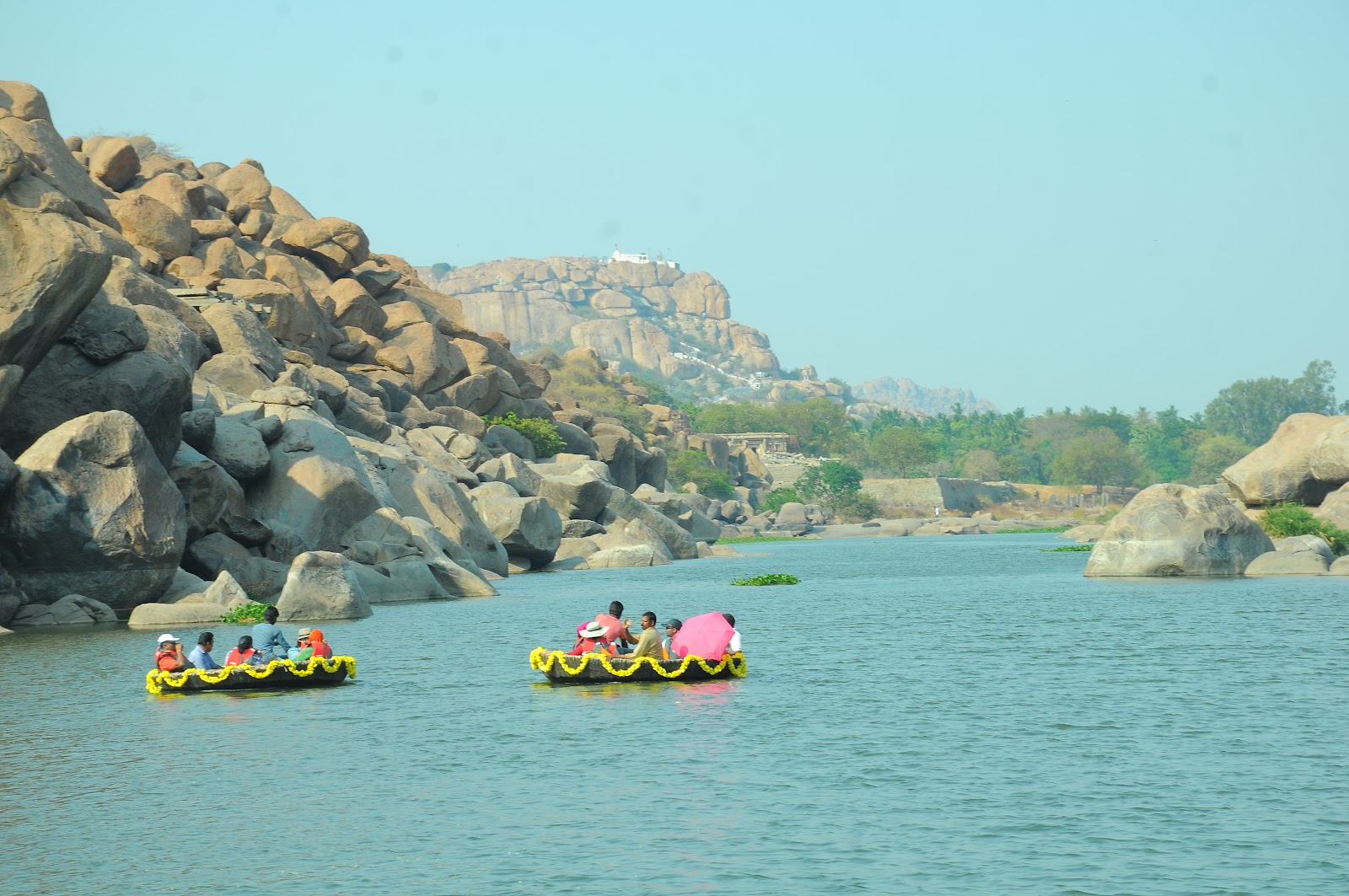
Customary coracle ride down the Thungabadra river : Pic courtesy JSW
The highlight of the process was an intense whirlwind tour of the Hampi ruins - a task that ordinarily requires about three days, but which we completed in one - with sunburn for free. There was enough and more to trigger the imagination, and in our writing we played with impressions of spaces that spoke to us. There was an element of psychogeography in many of our pieces, as our respective driftings and musings through the ancient city filtered down into our writing, in the form of images (elements of the Queen’s Bath, reliefs from the Hazara Rama and Virupaksha temples), particular architectural details (the famous musical pillars, the mixture of granite and soapstone), and the adoption of narrative points-of-view (the striking Frangipani tree in the Vittala temple complex).

Frangipani Tree in Vittala Temple Complex : Pic by Ram Ganesh Kamatham
Through reading we were able to tune into each other’s writing chops, and get a feel for each other’s sound and sometimes even detect a favoured turn of phrase. (For some reason, coracle, the famous round boats used to navigate the Thungabadra became a word that reduced the group to inexplicable laughter!)
All the work led to wonderful conversations about approach and craft, as each of us had adopted different strategies in the study of our subject. Madhulika Liddle’s approach was from historical fiction, and with masterful economy of language, she created a vivid picture of Hampi as it might have been in its heyday, a bustling city of commerce and culture, where souls and love might find or miss each other. I’ve now got her Muzaffar Jung omnibus on my reading list! Lalita Iyer, with her story, drew us into the world of Lakshmi the temple elephant and with this pachydermic-point-of-view immersed us into the life and times of the creature. I read her short story Roger, Over and Out earlier and her disarming confessional style had likewise effortlessly drawn me into the lives of the characters. Adopting a child’s point of view poses a challenge and I found both Prajwal Parajuly and Sathya Saran were able to do this convincingly. Sathya wrote a playful bit of dialogue between two stones in Hampi, but the piece that stayed with me was a short story about an artist and a mural that he had crafted. Her piece intrigued since it probed the psychological intention of the artist, a fertile ground for intelligent speculation. Prajwal’s story set in a convent school in Sikkim also adopted a child’s point of view, although this story was not connected to Hampi and was written in a fit of inspiration! The nun in his story kept admonishing the young protagonist for Americanisms in her speech, and Prajwal’s portrayal of her as a quaint custodian of the Queen’s English (and mindset) seemed ripe for gentle humour.
Amrita Tripathi’s piece created a charged atmospheric timelessness as she adopted the narrative voice of a tree, as a witness to events unfolding. Having heard an extract from her novel The Sibius Knot, where her use of language registered as sinewy and punctuated with sharp linguistic urbanisms, I got the impression that she was challenging herself by doing something very different. She succeeded - the piece she shared conjuring up a vivid sense of time dilation and gravitas. Siddharth Dasgupta’s poetry struck me as Sufi inspired, with ornate verbal juxtapositions suffused with tranquil rumination. His book designs too carried meticulous detailing and I was surprised to hear that the captivating cover to his collection of short stories The Sacred Sorrow of Sparrows, was his own design. Rochelle D’Silva’s spoken word poetry evoked hypnotic rhythms, coupled with keen observation of the world outside, as also an inner world. A moment in her poem about dragonflies, remains for me, an auratic photograph that captured the essence of being at Kaladham. I read her poem Waiting at Airports from her book When Home is an Idea, while at an airport, and had a liminal moment when my outer world and the inner world she described seemed to coincide! As for my own writing, I found myself poring over maps of the area and investigating how the ancient city met its end. The result was a satirical piece about the soldiers tasked with the unhappy mission of sacking the city.

The first of many discussions and readings at Kaladham : Pic Courtesy JSW
Now, I might have waxed poetic about pieces that the writers may well discard, edit out or dismiss as crude first attempts on their way to more considered output. I am also presenting a subjective view based on limited critical engagement with everyone’s work, and coloured by the rosy lens of bonding and bonhomie over ten days. Whatever the case, I’m convinced that the anthology of work that is due to emerge from this conclave will possess the same variety of expression and authenticity of voice, embodied by the group.
If a festival is a busy bazaar where wares are peddled and deals are wrangled, I am delighted to have been part of this unfestival. Here, as if at a quiet bookshop, I was able to unhurriedly turn pages to glimpse partial worlds, read words yet to be written, and smile at old friends and new.
This article first appeared in the Punch Magazine on March 31st 2018.
For another perspective on the conclave read:
Where Writerliness Matters: Notes from a Writer’s Retreat
Where Writerliness Matters: Notes from a Writer’s Retreat
Saturday, February 17, 2018
And once again I am blogging...
After many years of silence. I am blogging again.
For those of you who know me from my theatre days, the articles on foreign policy and strategy might be confusing. For those of you who I've met later on in an international setting, posts on art and culture will be a curiosity.
So here we go, an eclectic mix of culture and strategy, strategic cultures, and cultural views on strategy.
Why not!
For those of you who know me from my theatre days, the articles on foreign policy and strategy might be confusing. For those of you who I've met later on in an international setting, posts on art and culture will be a curiosity.
So here we go, an eclectic mix of culture and strategy, strategic cultures, and cultural views on strategy.
Why not!
Monday, December 04, 2017
The force of truth and political theatre: Prasanna
Prasanna has always intrigued and inspired me. His theatre career spans several decades and includes seminal productions such as Cupid’s Broken Arrow, Agni Barkha, Dekho Dragon Hindustani, Uttara Ramcharitram, and Akhri Kitab. He embodies a rare balance of energies. His life of firebrand political activism seamlessly dovetails into a refined aesthetic and directorial sensibility. Intellectually towering yet personally humble, his work both in the theatre and outside of it, has been ground breaking.

As a student in college I was an avid amateur participant in his theatre workshops. Many years later I was awed by his involvement with with Charaka and Desi,, a rural women’s co-operative producing and retailing handloom weaves. Bangalore at the time was being ravaged by an influx of business process outsourcing industries operating with little or no regulation. My interest in immaterial labour, such as that of call centre workers, led me to study classical labour movements. Charaka is a case study in things done right and remains a shining example of a contemporary social experiment that succeeded, creating a thriving rural economy, livelihoods and dignity of labour. Prasanna’s Gandhian khadi-spinning ashram in Bheemanakone, near Heggodu demonstrates the viability of sustainable living practices. His most recent campaign, fronted by the Gram Seva Sangha, successfully took on the blanket GST implementation in defence of handloom weavers who would be adversely impacted by the tax. The agitation also included the performance of a play Tayavva, a free adaptation of Brecht’s The Mother, among other activities. In his steadfast intellectual journey, he also published a book titled Indian Method in Acting. The publication is a novel experiment in situating Stanislavskian ideas into Indian performative idioms, and developing an indigenous vocabulary to describe and conceptualize actor training.

I managed to meet him during the GST satyagraha in Bengaluru. As a testament to his energy, he took time away from the hunger strike to give two interviews. I sat in on a conversation between Prasanna and Moodnakodu Chinnaswami, a Kannada poet and Dalit activist. Their debate centered around sustainability and sustainable living with the village as the locus of transformation. Their conversation sounded like a textbook debate between a Gandhian and an Ambedkarite, and after a short break I was able to talk to Prasanna.
RGK: Many of us working in the theatre today feel a tension between our art and our activism. Can you speak a little bit about this tension?
Prasanna: This crisis that you talk about, the crisis that a lot of theatre people, a lot of artists, are facing today – started with art becoming a commodity. The effects of this commodification are felt most strongly in the theater. Unlike other mediums theatre is a very attractive medium, because theatre people use their own body. The expression in theatre is semiotic, and not just intellectual. It is the most potential medium. And they commodified it! They brought in film, television and serials. Today there is no separation between theatre and money, theatre and the market. So with this crisis, a lot of theatre people became uncomfortable. They didn’t mind becoming marginalized, they didn’t mind producing their plays for small communities. They didn’t mind going into schools and working with children. But what they did mind was the fact that, what they were doing in the theatre, was being misused by some idiot capitalist.
I tried to handle this crisis for about two decades by actually training young actors. But then drama school itself became a television or cinema training center. Drama school stopped giving enough focus on vachika, angika and on drama itself. There was a lot of bullshit improvisation. There was a lot of letting your angst come out somehow. Either it was angst or sex that provided quick audiences and we theatre people went into that.
So I said let me go into real life. That is when I decided to go into the village. And started working with handloom weavers. The handloom weaver, or the potter or the cobbler, they are our cousins, and we have unfortunately forgotten this. Artists and artisans, the artist and the craftsperson are cousins. Even today in our folk art, they are the same. It is the artisan, who during the lean period performs or sings a song or writes a poem. That link has been completely damaged and what I am trying to do is re-establish that link. Today I am sitting on a fast, so that under the GST regime all handloom products should be tax exempt. There should be zero tax on handmade products. Why? Because I don’t want my cousins to die! They are poor cousins but very rich culturally. We are killing them. What is Mr Modi or Mr Siddahrammiah gaining out of this? It is only the market gaining.
In your conversation with Chinnaswami just now, you spoke about how GST will “ring fence” artisans into a marginal space…
The real is being ring fenced and the virtual is being propagated. The ring fencing that you are seeing most acutely in the village, seems to tell the small craftsperson, “Alright you pot makers, all right you cobblers, you just stay in the village. Stay in the village heart. Hum karenge. Hum pura desh or vishva ko chalayenge. Hum market ko chalayenge. (We will do it. We will run the entire country, the world and the market).” It’s the same bullshit. We are not going to allow this to happen. If it means that I have to stop producing plays, I don’t care.
What would your advice be to young theatre people just beginning their journey? How do they orient themselves politically? There seem a vast array of choices and camps to choose from… Ambedkarities, Gandhians… not to mention the various buzz-words out there… It can be confusing.
We are faced with discordant notes. We have been taught to look at everything in a discordant way, in a divided way. We have been taught that looking at anything holistically is wrong! For example, for my cousins in the folk theatre there is no distinction between morality and theatre. There is no distinction between God and theatre. When a folk performer performs, he is both performing a religious or a dharmic act and an entertainment. This marriage between entertainment and dharma is so vital and we have lost that link.
Today a theatre person does not know why he or she is performing. We should seriously ask ourselves this question. There is a very simple answer. The theatre person is holding the morality of the society aloft. The theatre person is a critic. But today what should they be criticizing? We have to criticize this discordancy, this fencing off of anything that is real and natural. We have to be talking about it, producing plays about it, singing about it. I think people have started doing this, so I’m not criticizing theater people. Because poor fellows they have to have their two meals! In spite of all these problems, theatre people are doing this. But society is not recognizing this. The society does not want to come to your play if you are not showing them your thighs or presenting some bullshit angst.
So on one hand there is this theatre of gratification and commodification, but on the other hand there is ideologically-driven theatre. It is often the case that agitprop or agenda-based theatre has little aesthetic or artistic merit. That’s not much of a choice.
No no. I am saying we should become Kabir all over again. Kabir was a practitioner and a saint. Theatre people should not feel shy of taking on this. We are shy and feel we are illiterates, but it is good that we are illiterates. We should not shy of become a Ravidas or Kabir. My play should do exactly what Kabir tried to do. He was also shunned while he was alive. Who cares for a weaver? Even in the fifteenth century. But we should do exactly what they did and not bother about how society will receive it. Tomorrow society will realise it was the theatre people who stood up for truth, when everybody else was chasing entertainment, money, and the market. Theatre people stood their ground. Isn’t this a great complement one can have from society, or from the gods?
Could you tell us a little bit about your contemporaries, especially when you just began working in the theatre, coming out of drama school (NSD). What was the situation like in Karnataka at the time?
Look we were all very lucky. Me and my generation. Bansi Kaul, Raina… we were post-Baba Karanth-ji. BV Karanth-ji was elder to me. We were lucky in the sense that when I came out of drama school in 1975, I arrived in an emergency-ridden Karnataka. I was not political in a real “party” sense. But we were all drawn to politics because of the emergency. And we used to go on a motorbike quietly to some party secretary of the Marxist party and we used to discuss things. And then we did plays. You see the 75 – 80 period when we did plays was an amazing time. Because we did street plays for the sake of the poor people who were trapped in the emergency, but at the same time we also did serious theatre, or what you would call the proscenium theatre, the 90 minute play. So we did both the 20 minute street play, and the 90 minute artistic theatre. And that is when I did my best productions. That is when I wrote my best work.
So I am lucky and I want you people to be lucky. Luck happens when you make an effort. See after the 80s, the smiling faced Rajiv Gandhi came to power in Delhi and the even more smiling faced Ramakrishna Hegde came to power in Karnataka. They were the ones who took away the entire artistic crowd, and made them into the zonal cultural center heads or academy presidents and members. And we did not know how to fight them. They would come to you, they were natural, they started treating you with respect. So in some way Indira Gandhi was a better thing because at least she had put the emergency in place! Though I have seen her in her better days, when she used to come and watch plays.
Whatever the case, it was in the 80s, on the one hand when you had these smiling-faced politicians, on the other hand all the channels started coming up. Thirdly, suddenly actors started getting money in Bombay. The crisis for me started then, that is when I said all right I don’t want to get into cinema and television. I don’t want to go to Bombay. Let me go and work with young actors. I had an example in front of me in KG Subramanyam. For decades, KG Subramanyam went, and worked with actors in Baroda school and in Shantiniketan. So I was very inspired by this. It was bad times. But in bad times I said let me at least prepare the young actors to face the bad times and do a good job and make good theatre. Between the 80s and now I kept on training actors. It was one of my best experiences because I could do a lot of young theatre. A lot of my productions in Delhi. Even my Uttara Ramacharitram, my Agni Barkha, Lal Ghas Par Neele Ghode were done during that time.
Once the Babri Masjid was broken, we entered even more terrible times. When you had to ask a question to an actor, “Are you a Muslim by any chance?” You had to ask, “Are you a Hindu or a Christian by any chance?” How can theatre survive in such an intolerant situation. You see recently Prakash Raj the actor compared Modi to himself. He said Mr. Narendra Modi is a better actor than me. What is wrong with that? Is a Prime Minister a better animal than an actor? If Prakash Raj said this, Modi should have laughed it off. But instead goons came after Prakash and tried to prevent him from getting a small award, which was in Shivaram Karanth’s name!
This is what we have entered into and these are terrible times of intolerance. People just don’t want to listen to anybody’s comments, especially critical comments. And if there is no critical comment, there is no theatre. Theatre is not about kissing or hugging the audience for heaven’s sake. The audience hugs you, but because you have been so critical of them and have made them aware of their own fallacies. They say “Thank you, you’ve made me aware that I am a bloody fool!” Today no bloody fool is willing to listen to theatre. Every bloody fool thinks that he is the brightest, youngest and most energetic philosopher on the Earth.
Is there anything that defines your intellectual position? Some years ago in Heggodu, we were at the khadi ashram and I was asking you about your intellectual journey. You said something that quite struck me as far as political philosophy was concerned. You told me that you actually came to Gandhi via Marx…
I would like to reframe that statement. Because I think, I have a better definition of what I am today. I want to reframe it as green socialism. We were all red socialists then. Today we are green socialists, and when I say this I do no simply mean that we looking into environmental issues or the forest. It means that you bring both the father and the mother in you. You bring both the purushaand the prakriti in you. You want to change, but you also want to retain tradition. The question we are facing today is what is tradition? Is the so called Vedic tradition the only tradition, or is it THE tradition? It is not. In India, for thousands of years people have recognized only one tradition, the tradition of the handmade. If you delink the karma, and the dharma, you are destroyed. Today we are delinking the two and we are supporting something which is supposed to be dharma but is actually most adharmic. Dharma is nature. Nature that you acquire through karma.
You know when you use these terms, you are also likely to run into trouble. You might be accused of disregarding secular language and being an advocate of Hindutva ideology!
We should be honest about this, and we should give credit to the Hindutva fellows. It is they, who told us that there is something called tradition and that we had better link up with it. We need to give them credit for this and then criticize them for showing off something as tradition that was not exactly tradition. So first I want to bow my head to all these reactionaries as we call them, whether they be Muslim, Hindu or Buddhist fundamentalists. They have shown a fundamental truth. We modernists had completely gone overboard on modernity, on “the machine”. It is they who pointed it out and now we have to define what is the true tradition. And what is the linkage between tradition and modernity, or tradition and contemporaneity. That we must do through our plays, our poems, work. That is the great task we have in front of us.
So in this push and pull of defining tradition and contemporary, you see political radicals advocating for tradition? Is that their role?
I want to call them (these radicals) intolerant. And when I say “You don’t be intolerant.” First of all I have to learn to be tolerant. If I become tolerant, they will shout at me and they might try to kill me, but eventually they have to become tolerant. Our plays have to become tolerant. We should be critical, but not intolerant. And this question of tolerance has to be treated philosophically. It has many dimensions and layers. We have been talking of tolerant as “me” and intolerant as “him” when both of us remain fighting. We have to go beyond that and explore this notion.
Isn’t tolerance some kind of intermediary stage before absorption? Someone like Rajiv Malhotra might argue that we are tolerant of someone only up until the point we can convert, co-opt or absorb them into our own type of thinking.
Well we have also got our definition of tolerance. This is where we simply do our work and don’t bother about the results. Intolerance comes when we are too eager about the results. There is a perceived result that we need to achieve and that is the source of the intolerance. Today I am sitting on a satyagraha, I should actually enjoy my hunger. Today I am experiencing hunger. Let me tell you the on the first day of the satyagraha, you suffer the worst pangs. Because your own system is telling you “Come on man eat, eat, eat. The second day, it pulls you, but a little less. By the third day, it settles and your system says, “Ok this man is not going to listen to me, so let me become natural.” Animals go hungry for many days, and they recuperate through this. There is everything to learn from them. If you do a play, you should enjoy the play and not bother about whether it will become a success. The result-oriented thinking is what is producing so much of intolerance. Tolerance is to just enjoy the work and let yourself go with the work, which is what Krishna is supposed to have said in the Gita, when he said “Karm karo, magar phal ke iccha na karo…”
One enduring facet of your work has been this metaphor of “the machine”. This was beautifully expressed in a public lecture of yours I attended in 2013. When you speak of machine culture and mechanization, I see it as a critique of modernity… But there’s also this nagging doubt that you can’t be a Luddite in this day and age. Can you really expect to reject the “machine” in totality?
Let us understand what we are angry about. What is this machine? What is this historical situation which we have reached. One is not angry with a machine for making things easier for us, which we can enjoy. But today the machine is environmentally destructive, and morally destructive. We need to come back to the real, the village life. What we are angry about is the disconnect a machine causes between you and your experience.
Well that’s alienation in a nutshell…
Yes, but let us look at it as an actor’s experience. You can call it rasa. But what is that moment of experience on stage? What the actor experiences on stage, looking into the eyes of the audience. It is the audience which is giving you your experience back. So there is an organic linkage between actor and audience. Between the play and the experience. Between the experiencer and the experienced. Machine breaks this link. When the audience yawned or cursed you, you would have corrected yourself. Actors crave this. This organic connection…
Prasanna thank you for this conversation and for agreeing to it despite being on a fast! I think your work is very interesting in this ever-green debate between juggling political and artistic impulses. Now there is another phrase that you have used “green socialism” which is stuck in my head…
[laughs] I am still very very red. I am still a very intolerant person, and I say this as a self-criticism. I don’t claim I am a saint. Long way off. Especially in the theatre when our deadlines are so severe, sometimes you lose your cool, and shout and lose sleep. Today I am on the satyagraha, but I want to talk about theatre today because I am in the other space. The best space is when you are not in the theatre space, to talk about theatre. When you are in the theatre, performing on stage, you talk about the real space or political space, or real life!
– – – – – – – – –
This article first appeared in the e-Rang Theatre Newsletter and was made possible with the kind support of Mallika Prasad, a long time collaborator of Prasanna.
Subscribe to:
Posts (Atom)